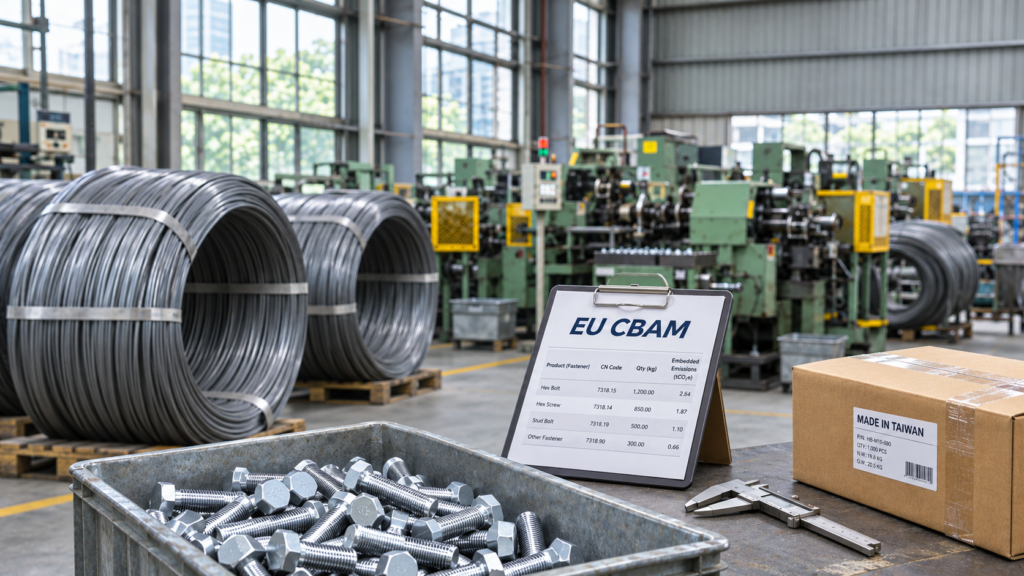
We have recently conducted an audit with a Taiwanese fastener factory, we covered the topic “CBAM” during the meeting. Here is what it is about…
If you source metal parts, screws, or steel from Taiwan, your vendor scorecard probably used to have three columns: price, quality, and lead time.
Since January 2026, a fourth column has quietly taken over: carbon.
Now that the European Union’s Carbon Border Adjustment Mechanism (CBAM) has moved out of its trial run and into its definitive phase, emissions aren’t just an annual sustainability report footnote anymore. They are a real line-item cost. For procurement teams and business owners buying from Taiwan, the tricky part isn’t just the EU border tax itself—it’s how that tax collides with Taiwan’s own new carbon fee back home.
The 2026 Reality: The Meter Is Already Running
EU importers don’t actually have to buy CBAM certificates until February 1, 2027, and the first annual declaration isn’t due until September 30, 2027. Because those dates feel a little ways off, a lot of buyers and suppliers have been dragging their feet.
That is an expensive mistake. Every container landing in Europe right now is already accruing a carbon bill.
Last year, the EU bought roughly €3.43 billion (2.40 million tonnes) of CBAM-covered goods from Taiwan, putting the island in the top ten non-EU suppliers by value. With CBAM certificate prices hovering around €82.32 per tonne of $\text{CO}_2\text{e}$ in Q3 2026, the gap between verified low-carbon steel and the EU’s punitive “default values” can tack nearly €100 per tonne onto standard hot-rolled steel. On tight industrial margins, that wipes out the profit on a deal overnight.
Why Small Fastener Factories Are Caught in the Middle
Taiwan’s Ministry of Environment estimates that around 2,600 local companies are caught in CBAM’s net—split almost evenly between factories (53.3%) and trading houses (46.7%).
Big players like China Steel Corporation (CSC) saw this coming years ago. They have dedicated ESG departments and direct lines to European regulators. The real squeeze is happening down in Kaohsiung and Tainan, among Taiwan’s dense network of small and medium-sized screw, bolt, and metal-processing shops.
Roughly 2,200 of those Taiwanese exporters ship fewer than 50 tonnes a year to Europe. Naturally, a lot of them looked at the EU’s 50-tonne annual exemption threshold and assumed they were off the hook.
They aren’t. The 50-tonne limit isn’t measured by what a Taiwanese factory ships—it’s measured by what the European importer brings in across all suppliers combined. If a German hardware distributor buys 5,000 tonnes of fasteners a year globally, every single 10-tonne order from a small Taiwanese workshop has to be declared. If that workshop can’t hand over verified emissions numbers, the distributor either eats a massive default-value penalty or drops the supplier.
Taiwan’s Carbon Fee: Help or Headache?
While European customs officials are tightening the screws from the outside, Taiwan rolled out its own domestic carbon pricing in 2026. The Ministry of Environment is now collecting a carbon fee from major local emitters—companies pumping out more than 25,000 tonnes of $\text{CO}_2\text{e}$ a year, which includes power plants, petrochemical giants, and upstream steel mills.
| What to Know | Taiwan Carbon Fee | EU CBAM |
| Who pays directly? | Big local emitters (>25,000 tonnes/year) | EU importers bringing covered goods into Europe |
| Where things stand | Collection active in 2026 | Live since Jan 2026; certificate buying starts Feb 2027 |
| The price tag | Standard: NT$300/tonne (~€8.70) Discounted: NT$50–100/tonne | Pegged to EU ETS prices (€82.32/tonne in Q3 2026) |
| Effect on SMEs | Indirect—shows up as higher raw steel prices | Indirect—buyers demand emissions data to keep orders |
Don’t Count on a 1-for-1 Tax Credit
On paper, EU rules (specifically Article 9) let importers deduct any carbon price already paid in the country of origin so goods aren’t taxed twice. In practice, buyers shouldn’t expect Taiwan’s carbon fee to make their CBAM bill disappear:
- The math doesn’t close the gap: Taiwan’s standard fee of NT$300 per tonne (~€8.70) is roughly **11% of the EU’s €82.32 rate**. Worse, major steelmakers that file approved carbon-reduction plans qualify for preferential rates of NT$50 to NT$100 per tonne. That keeps local steel prices from spiking, sure, but it leaves almost nothing to deduct at the European border.
- The paperwork is still a mess: Taipei and Brussels have agreed in principle that Taiwan’s carbon fee counts as a legitimate carbon price. But the fine print—how to prove an upstream mill’s fee was passed down into a batch of finished bolts, which exchange rates apply, and what audit trail EU verifiers will accept—is still being ironed out. Until third-party auditors can trace a NT$100 fee from a blast furnace in Kaohsiung all the way to a box of screws in Rotterdam, claiming that deduction is going to be uphill work.
Four Moves for Buyers Sourcing from Taiwan
You can’t just email a 40-person screw factory in southern Taiwan and demand an EU-compliant carbon audit by Friday. At the same time, walking away from Taiwan’s fastener cluster isn’t realistic—few places on earth match its tooling speed, specialization, and reliability.
If you want to keep your supply chain intact heading into 2027, focus on four practical steps:
- Check your cumulative volume first. Confirm whether your EU entity crosses the 50-tonne annual mark across all CBAM product categories. If you’re over the line, tell every Taiwanese vendor right now—even the small ones—that you will need actual emissions data for 2026 shipments.
- Stop relying on EU default values. In 2026, using the EU’s default emissions numbers doesn’t just give you a conservative estimate—it adds a 10% punitive surcharge on top (which climbs to 30% by 2030). Help key suppliers set up basic facility-level tracking (aligned with ISO 14064-1 or ISO 14067) so you can report real numbers.
- Get vendors onto the EU CBAM Operators Portal. A lot of Taiwanese SMEs don’t realize they can register directly on the European Commission’s portal. Once a supplier uploads a third-party verification there, they can share it with multiple European customers at once instead of paying for separate audits for every buyer.
- Put carbon clauses into 2027 contracts. Right now, Taiwanese mills are passing local carbon fees into wire rod prices, while EU importers are staring down CBAM certificates. Spell out who absorbs what in your next contract cycle, and give longer volume commitments to suppliers using electric arc furnace (EAF) steel or recycled feedstock.
Taiwan’s government is pumping subsidies and technical consultants into its manufacturing hubs to help smaller factories get their carbon accounting in order. For international buyers, the smart play isn’t treating CBAM as a customs compliance headache—it’s locking in the Taiwanese suppliers who are actually doing the work to decarbonize before everyone else scrambles for their capacity in 2027.