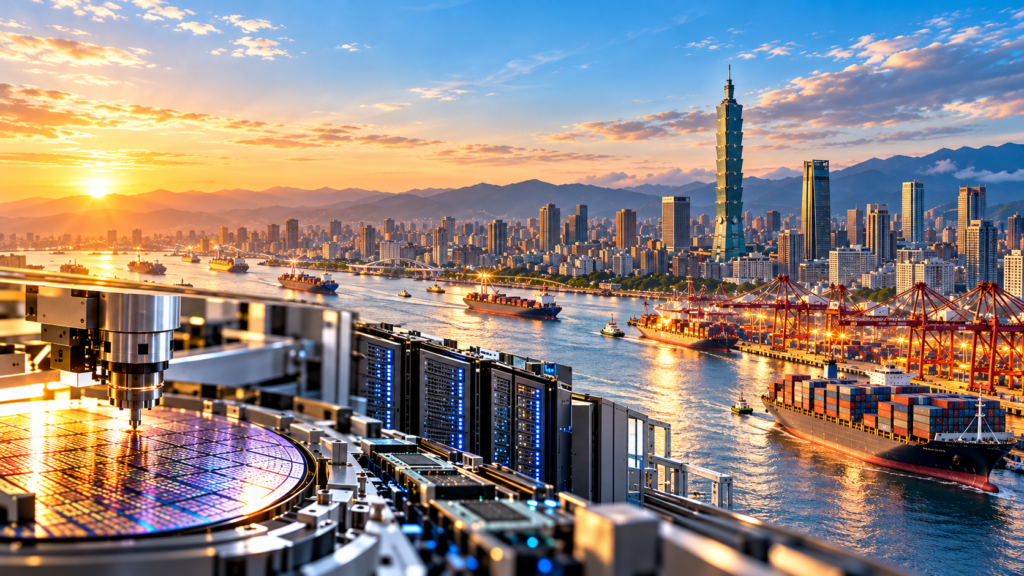
From record-breaking exports to the global AI boom, Taiwan is showing why it remains one of the world’s most important technology and manufacturing hubs.
If you’ve been following Taiwan’s economy this year, it’s hard to miss how much has changed.
The stock market has climbed to remarkable levels. Exports are breaking records. Economic growth has exceeded expectations, and much of this momentum can be traced back to one industry: artificial intelligence.
But there’s more to the story than AI.
Behind these impressive numbers is a manufacturing ecosystem that Taiwan has spent decades building. From semiconductors and electronic components to precision machinery and industrial equipment, Taiwanese manufacturers have become an essential part of supply chains around the world.
So, how is Taiwan actually doing in 2026? And what does its economic performance mean for businesses looking to work with Taiwanese suppliers?
Let’s take a closer look.
1. Taiwan’s Stock Market Has Had an Extraordinary Year
Taiwan’s stock market has been one of the most talked-about indicators of the country’s economic strength in 2026.
As of October 8, the Taiwan Stock Exchange Capitalization Weighted Stock Index (TAIEX) had reached 49,313 points, up approximately 70% from the end of 2025.
That’s an impressive gain, even for a market with a strong concentration of technology companies.
Much of the excitement comes from the semiconductor industry, particularly TSMC, which continues to play a major role in manufacturing the advanced chips used in AI systems.
The growing demand for AI processors, computing infrastructure, and advanced chip packaging has brought renewed attention to Taiwan’s technology sector.
Of course, a rising stock market doesn’t necessarily mean every industry is enjoying the same level of growth. Technology stocks account for a substantial share of the index, and market valuations can change quickly.
Still, the performance tells us something important: investors are placing considerable confidence in Taiwan’s role in the next generation of technology.
2. Economic Growth Is Exceeding Expectations
Taiwan’s GDP figures have been another major highlight this year.
According to the Directorate-General of Budget, Accounting and Statistics (DGBAS), the economy grew by 15.43% year-on-year in the first quarter of 2026, followed by 12.93% in the second quarter.
The government’s latest forecast puts full-year GDP growth at 11.05% for 2026.
These are unusually strong numbers for a developed, export-oriented economy like Taiwan.
A large part of this growth comes from overseas demand. As companies around the world invest heavily in AI infrastructure and computing capacity, Taiwanese suppliers are receiving more orders for chips, servers, and electronic equipment.
It’s also worth remembering that Taiwan’s economy isn’t built around one company or one product. Thousands of businesses support the country’s technology and manufacturing industries, including component manufacturers, equipment suppliers, engineering companies, and specialized factories.
That network of suppliers is one of Taiwan’s biggest strengths.
For overseas buyers, it means access to much more than finished products. Taiwan offers engineering experience, manufacturing expertise, and suppliers capable of handling specialized production requirements.
3. What Other Economic Indicators Tell Us
GDP and stock market performance often get the headlines, but other economic indicators help paint a fuller picture.
Taiwan’s unemployment rate stood at 3.41% in August 2026, while consumer prices rose 2.73% year-on-year in September.
Meanwhile, Taiwan’s National Development Council reported an economic monitoring score of 41 points for August, keeping the country’s economic signal in the red zone, which indicates strong economic activity.
Taken together, these figures suggest that economic momentum has remained strong, particularly in export-related industries.
There are, however, differences between sectors.
Businesses connected to AI, semiconductors, and advanced computing have benefited greatly from the current investment cycle. Traditional manufacturers, on the other hand, may still face challenges from international competition, exchange-rate movements, and changing customer demand.
That’s an important distinction.
Taiwan’s economy is performing exceptionally well overall, but companies still need to choose their markets, products, and suppliers carefully.
4. Taiwan’s Exports Are Breaking Records
If there’s one statistic that captures Taiwan’s economic momentum in 2026, it might be its export figures.
In September alone, Taiwan exported US$87.22 billion worth of goods, a 60.9% increase compared with the same month in 2025.
Imports also increased significantly, reaching US$63.59 billion, while the monthly trade surplus stood at approximately US$23.63 billion.
These are remarkable figures for an economy of Taiwan’s size.
So, what’s driving all this activity?
AI-related products are a major reason. Servers, computer equipment, semiconductors, and electronic components have seen particularly strong international demand.
Taiwan’s export mix has also been evolving.
Computing hardware is becoming increasingly important, reflecting the country’s growing involvement in global data center construction and AI infrastructure projects.
For buyers and manufacturers, strong export figures also point to something practical: Taiwan’s factories are deeply connected to international markets.
Many Taiwanese suppliers have years of experience handling overseas orders, meeting international quality requirements, and working with customers on customized product specifications.
These are advantages that aren’t always visible in economic statistics, but they matter when choosing a long-term manufacturing partner.
5. AI Is Changing Taiwan’s Economy — and Its Manufacturing Industry
Artificial intelligence is probably the biggest reason Taiwan’s economy is attracting so much international attention right now.
When people think about AI, they usually think of software, chatbots, or companies developing large language models.
But all of those technologies depend on physical infrastructure.
AI systems need advanced chips, powerful servers, cooling equipment, power supplies, circuit boards, and countless other components to operate.
And that’s where Taiwan comes in.
TSMC is one of the world’s most important manufacturers of advanced semiconductors, producing chips for leading technology companies.
At the same time, manufacturers such as Foxconn, Quanta, Wistron, and Wiwynn are deeply involved in producing servers and other computing hardware.
The opportunities don’t stop with these large companies.
Smaller and medium-sized Taiwanese manufacturers contribute through precision parts, electronic assemblies, connectors, thermal management solutions, industrial automation, and other specialized products.
In many cases, these companies might not be familiar names outside Taiwan, but their products are used in equipment sold around the world.
This is what makes Taiwan’s manufacturing ecosystem so interesting.
A company developing a new electronic product may need a PCB manufacturer, a metal parts supplier, a plastic injection molding factory, and an assembly partner. In Taiwan, it’s often possible to find all of these capabilities within a relatively connected industrial network.
AI is creating new demand, but the infrastructure and manufacturing knowledge supporting that demand have been developing for decades.
6. Why We’re Optimistic About Taiwan’s Future
Looking ahead, there are good reasons to be optimistic about Taiwan’s economy.
Global investment in AI infrastructure is expected to remain an important source of demand. Taiwan’s semiconductor and electronics industries are well positioned to benefit from that investment, while continued innovation is opening up opportunities in automation, robotics, and advanced manufacturing.
Another advantage is Taiwan’s flexibility.
Many Taiwanese manufacturers have built their businesses around working closely with international customers, adapting designs, improving products, and producing specialized components.
For companies that need something more customized than a standard catalog product, this experience can be especially valuable.
Of course, there are challenges ahead.
Geopolitical uncertainty, changing international trade policies, energy requirements, and fluctuations in global technology demand could all affect Taiwan’s growth.
And after such an exceptional year, it would be unrealistic to assume that GDP, exports, or the stock market will continue growing at the same pace indefinitely.
Even so, Taiwan has several strengths that are difficult to replicate: experienced engineers, an established supplier network, advanced manufacturing capabilities, and decades of international trade experience.
These are the foundations that give us confidence in Taiwan’s long-term potential.
Final Thoughts
2026 has been an exceptional year for Taiwan so far.
Strong GDP growth, a rapidly rising stock market, record exports, and the expansion of AI-related industries have all contributed to a positive economic outlook.
But perhaps the most encouraging part of the story is what sits behind these numbers.
Taiwan’s strength comes from years of investment in technology, manufacturing expertise, and long-standing relationships with customers around the world.
Whether the next opportunity comes from AI, industrial automation, electronics, or another emerging industry, Taiwan has a solid foundation to build on.
At ASK TAIWAN, we believe Taiwan still has plenty to offer the world — and that there are many opportunities ahead for businesses willing to explore them.
Looking for Suppliers in Taiwan?
At ASK TAIWAN, we work with international businesses looking for reliable manufacturers and sourcing partners in Taiwan.
If you’re exploring new suppliers, developing a product, or looking for manufacturing solutions, we’d be happy to help you find the right partners.
Get in touch with ASK TAIWAN and discover what Taiwan’s manufacturing industry can offer your business.
Data as of October 12, 2026. Full-year GDP figures are forecasts and are subject to revision.
Sources: Taiwan Stock Exchange (TWSE), Directorate-General of Budget, Accounting and Statistics (DGBAS), Ministry of Finance (MOF), National Development Council (NDC), and TSMC Investor Relations.